

In today’s rapidly evolving digital landscape, enterprises are transitioning from legacy mainframe systems to leverage the scalability, flexibility, and cost-efficiency of cloud platforms. For organizations relying on Virtual Storage Access Method (VSAM) and Non-VSAM (GDG, PS etc.) datasets, migrating these critical assets to TmaxSoft OpenFrame using DDM zLift offers a robust solution. This integration enables seamless migration of VSAM and Non-VSAM datasets from mainframe disk and Tapes and EBCDIC to ASCII conversion, ensuring data integrity and operational continuity while harnessing the power of AWS. This blog explores how DDM zLift and TmaxSoft OpenFrame work together, the benefits of this integration, and why it’s an ideal choice for mainframe-to-cloud migration.
The Challenge of Mainframe-to-Cloud Migration
Mainframes remain critical for mission-critical applications in industries like finance, insurance, and healthcare. However, their maintenance is costly, and integrating them with modern cloud architectures presents several challenges:
 EBCDIC Data Handling: Mainframe data, typically stored in EBCDIC format (e.g., VSAM, GDGs etc.), requires precise handling and conversion to ensure compatibility with cloud environments.
Data Integrity: Accurate data migration is essential to prevent errors or data loss.
Automation: Manual migration processes are prone to errors, disrupting workflows.
Scalability: Legacy systems lack the scalability of modern cloud platforms.
DDM zLift, integrated with TmaxSoft OpenFrame, addresses these challenges by providing an automated, scalable, and reliable pipeline for migrating VSAM datasets to OpenFrame’s rehosting environment on AWS.
How DDM zLift and TmaxSoft OpenFrame Work Together
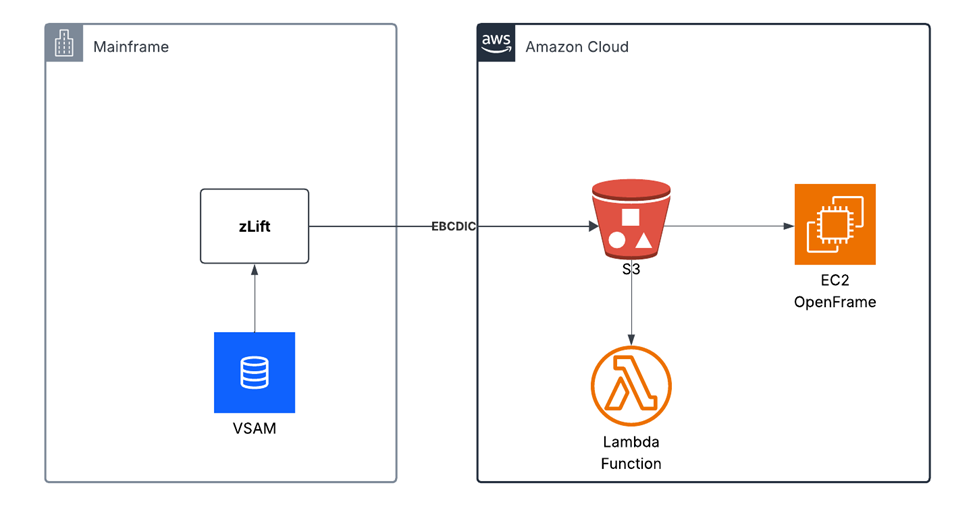
The integration of DDM zLift with TmaxSoft OpenFrame creates an efficient pipeline for migrating VSAM and Non-VSAM datasets from mainframes to TmaxSoft OpenFrame, preserving EBCDIC format while data transfer and do ASCII conversion at target and leveraging AWS services like Amazon S3, Lambda, EC2, and Systems Manager (SSM). Here’s how it works:
1 . Reading VSAM Dataset Lists:
DDM zLift accesses a Physical Sequential (PS) file containing a list of VSAM and Non-VSAM datasets to be migrated.
This PS file acts as a catalog, ensuring all relevant datasets are identified for migration.
2. Uploading to Amazon S3 in EBCDIC Format:
DDM zLift reads the VSAM and Non-VSAM datasets and data is uploaded to an Amazon S3 bucket in their native EBCDIC format to preserve data integrity.
Copybooks are also uploaded to S3, providing schema information for downstream processing. Copybooks data is converted from EBCDIC format to ASCII format.
3. Triggering AWS Lambda:
An S3 event triggers an AWS Lambda function upon data upload.
The Lambda function orchestrates subsequent steps, ensuring automation and scalability.
4. Invoking OpenFrame Scripts via AWS SSM:
The Lambda function uses AWS SSM to invoke OpenFrame scripts on an Amazon EC2 instance running OpenFrame.
These scripts utilize the copybook to define the VSAM and Non-VSAM structure in the OpenFrame environment.
5. Creating VSAM Clusters and NON-VSAM datasets with TmaxSoft OpenFrame’s IDCAMS tool:
OpenFrame’s IDCAMS utility, creates a VSAM cluster and NON-VSAM datasets on the OpenFrame instance using the copybook. This ensures the migrated data retains its original structure and format.
6. Migrating Data with TmaxSoft OpenFrame’s DSMIGIN tool:
The OpenFrame’s DSMIGIN command converts the EBCDIC data from S3 into ASCII and loads to the newly created structures.
Data is validated for Logical Record Length (LRECL) and format to ensure no data loss.
This end-to-end pipeline automates the VSAM and Non-VSAM data migration process, minimizes manual intervention, and integrates seamlessly with OpenFrame infrastructure.
Benefits of DDM zLift and TMaxSoft OpenFrame Integration
1. Preserves Data Integrity:
Maintains EBCDIC format during transfer, ensuring no data corruption.
Validates data using IDCAMS and copybooks to prevent issues.
2. Scalable and Automated:
Leverages AWS Lambda and SSM for event-driven automation, eliminating manual steps.
OpenFrame’s scalability on EC2 supports horizontal and vertical scaling, ideal for handling large VSAM datasets.
3. Cost-Efficient:
Reduces mainframe operational costs by up to 60% by rehosting applications on cost-effective x86 EC2 instances.
Minimizes code changes, preserving existing business logic.
4. Cloud-Native Integration:
OpenFrame supports integration with Tibero for relational data storage.
5. Error Prevention:
Avoids common migration pitfalls, such as LRECL mismatches, through automated validation in OpenFrame tools.
Why This Integration Stands Out
No Code Changes: OpenFrame rehosts COBOL, Assembler, PL/I, and other applications without modifying business logic, ensuring continuity.
Error-Free Migration: Automated validation through Lambda and IDCAMS prevents issues like LRECL mismatches or duplicate keys.
Future-Proof: Unlocks mainframe VSAM and Non-VSAM data for modern analytics with AWS EMR, Athena, or other cloud databases, enabling cloud-native applications.
Get Started with DDM zLift and TmaxSoft OpenFrame
Ready to modernize your mainframe with DDM zLift and TmaxSoft OpenFrame? This solution simplifies VSAM migration to OpenFrame, reducing costs and enhancing agility. Request a demo or contact us to see it in action.
Leave A Comment